
Hinesville City Directory Sources
Hinesville's directory shelf begins with the Hinesville Genealogy Room at the Hinesville Library, but its exact city directory and telephone-book holdings are not published in an accessible official catalog. Call 912-368-4003 and ask staff to inspect title pages, dates and call numbers before planning a visit. That direct check matters. A digitized 1950 R. L. Polk volume in the regional system is a Savannah directory, not a Hinesville edition, and it cannot prove that a comparable Hinesville run exists.
| Collection | Years | Where Held | Access |
|---|---|---|---|
| Hinesville directories, phone books and reverse volumes | Exact run unresolved | Hinesville Genealogy Room | Confirm by phone, then use in person |
| Hinesville Gazette | 1872-1876 | Georgia Historic Newspapers | Free digitized run |
| Liberty deeds and mortgages | Images 1777-1920; index 1777-1958 | FamilySearch | Free login; limits may apply |
| Federal census | Through 1950 | Library databases, NARA and FamilySearch | Online or library access |
| Liberty estate records | 1775-1892 | FamilySearch catalog | Catalog and film access |
This table separates verified coverage from the unresolved directory run. It is better to document a gap than assign Hinesville the publisher or years of a Savannah book. Branch staff may find local phone books or reverse directories that have not been described online. Ask whether the item is on paper or microfilm, whether a reader is available and whether copying is allowed.
A useful catalog inquiry also asks whether the collection is filed under Hinesville, Liberty County, a telephone company or a publisher. Local books can be shelved by county even when the title names a city. Record negative answers as well as positive ones. Knowing that no reverse volume exists for a decade prevents wasted work and directs the search toward tax rolls, newspapers and census schedules.
Hinesville Genealogy Room Search
The Hinesville Genealogy Room is at the Hinesville Library, 236 W. Memorial Drive. Its tools include Ancestry Library Edition, HeritageQuest, African American Newspapers 1827-1998, Georgia Historic Newspapers and FamilySearch pathways. Those databases can fill a missing city directory year with a census household, newspaper notice or deed reference.
Give staff a short, specific request: the person's full name, likely years, known street, spouse or relative, and whether you need alphabetical or street-order material. Ask separately about Hinesville and Liberty County telephone books, reverse or criss-cross editions, yearbooks, obituary indexes and unpublished finding aids. A branch answer about title pages and call numbers is the sound basis for describing the local run.
Note: Confirm branch hours and reader availability before traveling with a long list of directory years.
Hinesville Records Beyond Directories
When the Hinesville city directory shelf has a missing year, move to a record created near the same date. The Georgia Archives research-help service routes researchers to Liberty County microfilm and catalog cards, including pre-1900 deeds, estate papers, marriage material, tax records and court minutes. Its reading room has set pull hours, so identify the county, record group and date range first.
The Archives screen below shows the research entry point. It helps turn a vague family name into a request for a specific Liberty County volume or film.
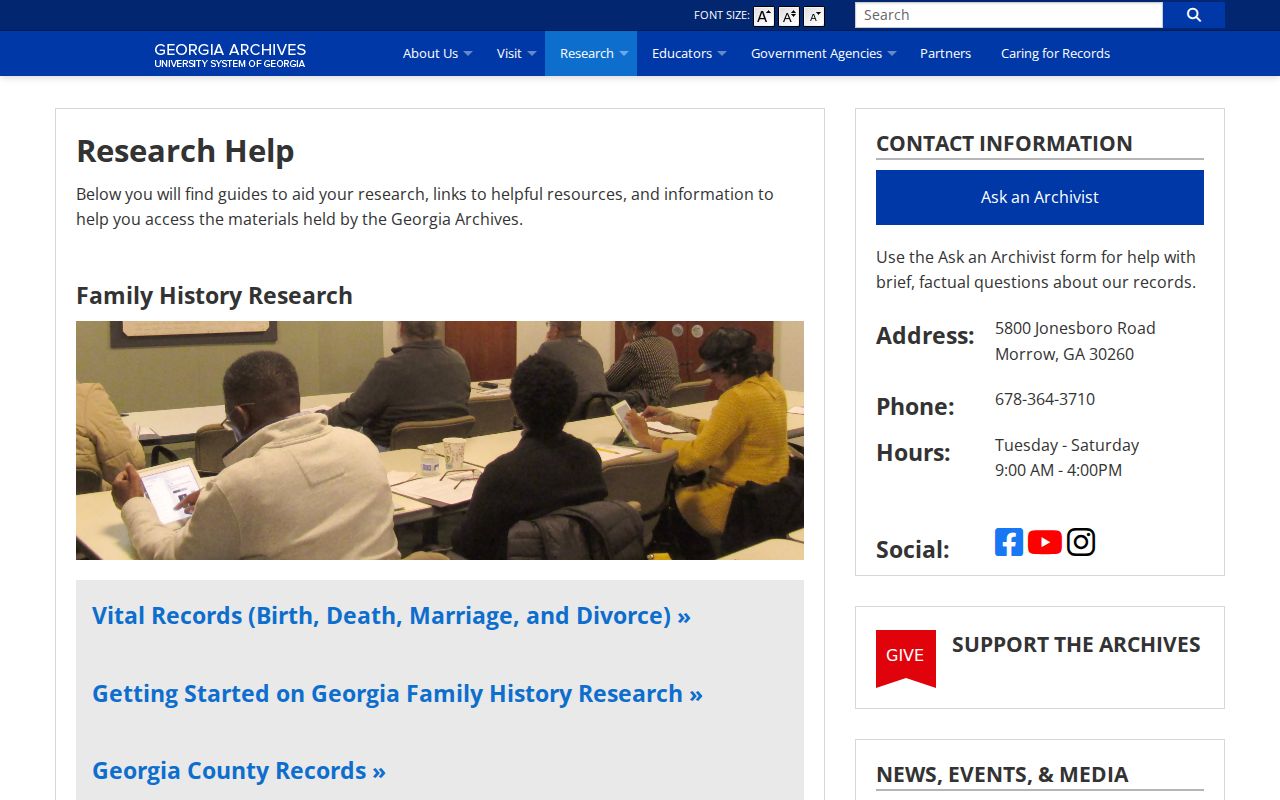
Use the catalog result as a pointer. A transcription, index entry or directory listing should be checked against the underlying image when the exact spelling, date or legal relationship matters.
Georgia Archives county cards are especially helpful for pre-1900 research. Liberty County material includes deeds, estate and probate records, marriages, tax records and court minutes on microfilm. The African American research guide also identifies separate Liberty apprenticeship and indenture registers, while estate papers may name enslaved people. These sources require careful historical reading and should be cited by the record title, volume and page, not described loosely as a city directory.
Liberty Records Name Local Families
The Georgia Historical Society's Liberty County records finding aid describes an unrestricted group from 1789-1797, including a militia payroll, battalion return and marsh-land statement. These are not city directories. They can put named people into Liberty County long before a modern alphabetical directory would be expected.
The finding-aid image shows the collection-level description used to decide whether the papers fit a Hinesville or Liberty County line of research.
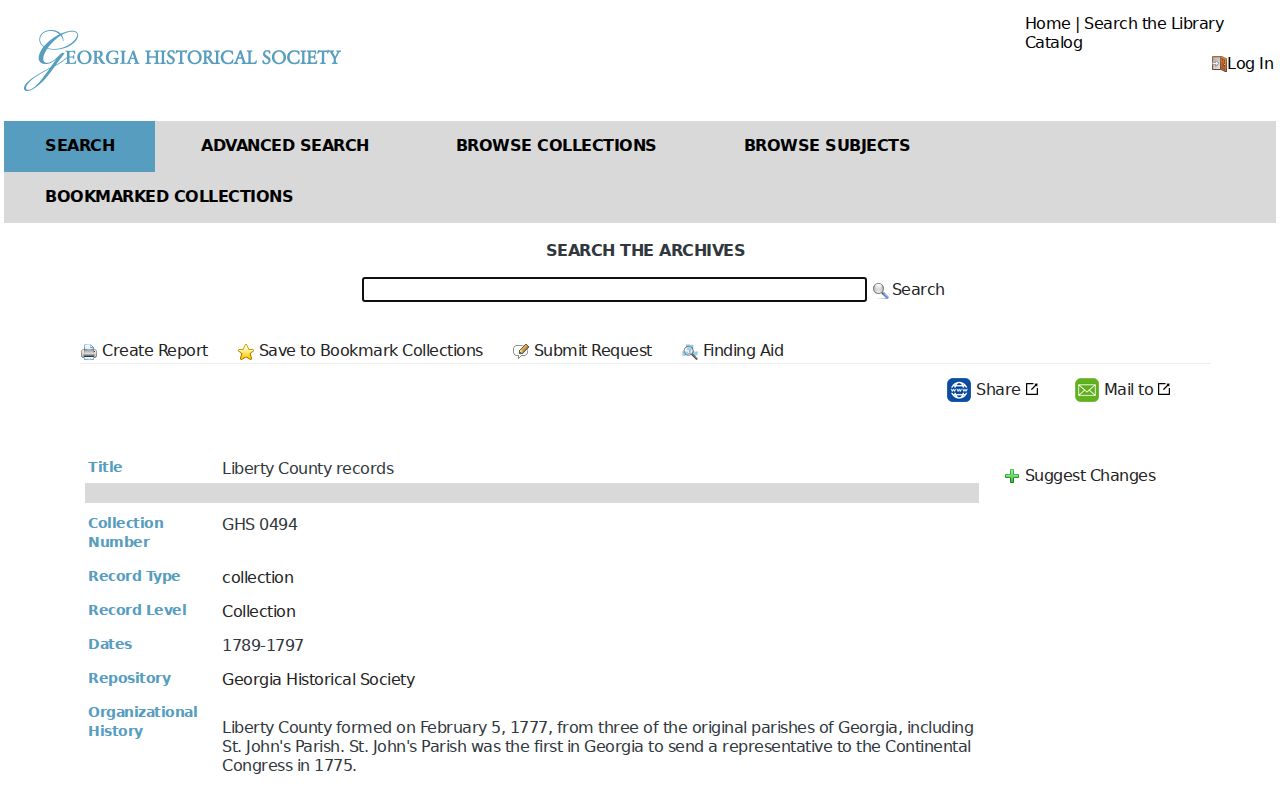
Pair such an early reference with deeds, probate files and cemetery material. A payroll proves a person appears in that record; it does not establish a home address or continuous residence.
Reading Hinesville Directory Entries
No viewable Hinesville entry was verified, so do not assign local volumes a specific symbol system. Most directories require the reader to consult the front matter and abbreviation key before interpreting a line. Record the text exactly, including initials, spouse notation, street form and any mark tied to ownership or boarding. Then photograph or copy the key that defines those abbreviations.
| Name | Copy surname, given name and initials as printed; keep similar names separate. |
|---|---|
| Household clue | Note a spouse, widow notation or other relationship only when the volume defines it. |
| Work line | Record an occupation or organization, but do not assume that address is a home. |
| Address | Preserve house number, street spelling, directional and apartment or rural-route detail. |
| Symbols | Check the volume's own key before interpreting ownership, residence or boarding marks. |
- Criss-cross directory
- A directory arranged by street and house number rather than only by surname.
- Householder index
- A list centered on the named head or primary person associated with an address.
- Abbreviation key
- The volume's own legend for shortened words and symbols, often placed near the front.
A single line is a dated lead, not proof that every family member lived there for the whole year. Publication cutoffs, shared phone service and unlisted households all affect coverage.
Hinesville Telephone Directory Clue
A 1946 history of the Hinesville Telephone Company counted 253 accounts: 157 residence accounts, 70 business accounts and 24 paystations. That small network explains both the value and the limits of a period phone book. A listed residential account could place a subscriber in the community, while a shared line, non-subscriber or person living on Fort Stewart might not appear at all.
Treat the number as a snapshot of telephone service, not a population count. Compare a suspected subscriber with the nearest census, newspaper notice and deed or tax entry. This is a useful myth check: an absent name does not prove that the person was absent from Hinesville.
The account mix also helps interpret an address. A business line can name a shop, office or public place rather than a household. A paystation can mark a service point without naming its daily users. If branch staff locates a 1940s phone book, preserve the classification and heading around each entry so a residence listing is not confused with a business or institutional number.
Hinesville Archives Bridge Family Gaps
Vital and probate records can explain why a name changes or disappears from a city directory. Georgia's statewide birth and death registration began in 1919, while older marriage, church and probate material may reach farther back. The Georgia Archives vital-records overview sets out that historical framework.
The archived resource shown here is a companion to directory research, especially when a death, marriage or delayed birth may explain a break in the annual trail.
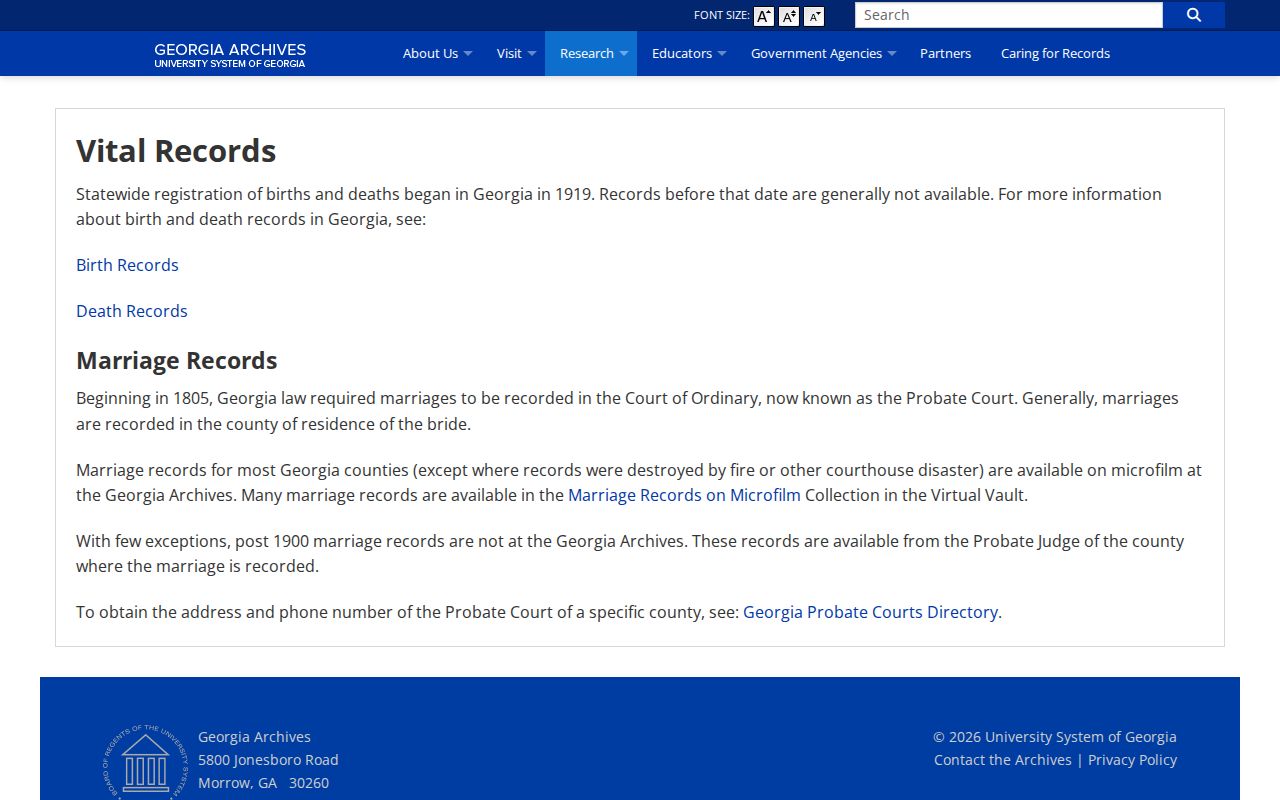
Access rules still apply. A historical index may be open while a certified copy is limited to qualified requesters, and the index should not be treated as the certificate itself.
Trace Hinesville Families by Directory
Build a timeline instead of treating one city directory hit as a final answer. Fort Stewart's mobile population makes a one-edition appearance plausible, and civilian and on-post addresses must be kept distinct. Copy each dated fact before moving to the next source.
- Ask the library for the closest available volume and copy the entry, title page, publication date and abbreviation key.
- Check the editions immediately before and after it. Log every street change and spelling variant.
- If a street-order section exists, inspect the address and nearby householders without assuming they were related.
- Pair the trail with the nearest released federal census, available through 1950, to test ages, relationships and birthplace.
- Use deeds, probate, newspapers and cemetery sources to explain a move, death or transfer.
A person may vanish because of a move, death, omitted listing, shared line or publication gap. Search the Hinesville Gazette for the older 1872-1876 period, then use probate or deed records when the name is tied to an estate or parcel. For a current one-person check, move to the Hinesville resident lookup and verify against present official indexes.
Keep a source log with one row per year. Include the volume title, page, exact name form, address, associated person and the next source checked. Mark an unsuccessful search as “not found in this volume,” never “not living in Hinesville.” That wording preserves the difference between what a directory printed and what actually happened in the community.
Hinesville Probate Records Add Kin
The Liberty County Probate Court handles estates, wills, marriage and local vital services at 201 S. Main Street, Suite 2200. Estate records can identify decedents, heirs and administrators when a household drops from a directory. Historical FamilySearch coverage includes estate accounts from 1818-1874 and estate records from 1775-1892.
The official Probate Court page pictured below is the starting point for current counter details and copy questions.
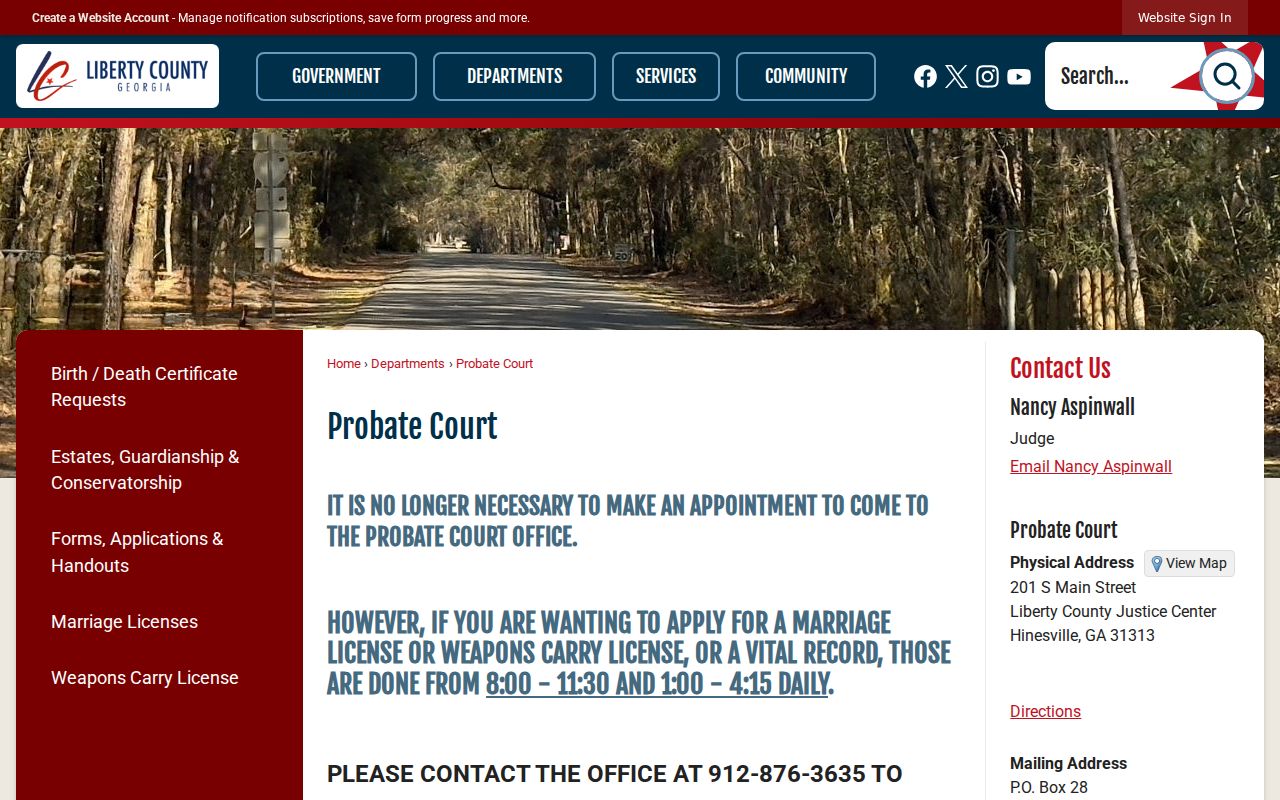
Ask for an existing file by a decedent's name and likely date. Certified marriage copies cost $10 in the researched schedule, while estate name examinations and page copies use separate fees.